Virtual Reality in Education: Revolutionizing the Way We Learn
Virtual Reality (VR) is transforming education by creating immersive, interactive, and engaging learning experiences. Unlike traditional learning methods that rely on textbooks, lectures, or videos, VR places learners inside a fully simulated environment where they can explore, interact, and learn by experience. As technology advances and becomes more accessible, virtual reality is reshaping classrooms, training programs, and online education around the world.
What Is Virtual Reality in Education?
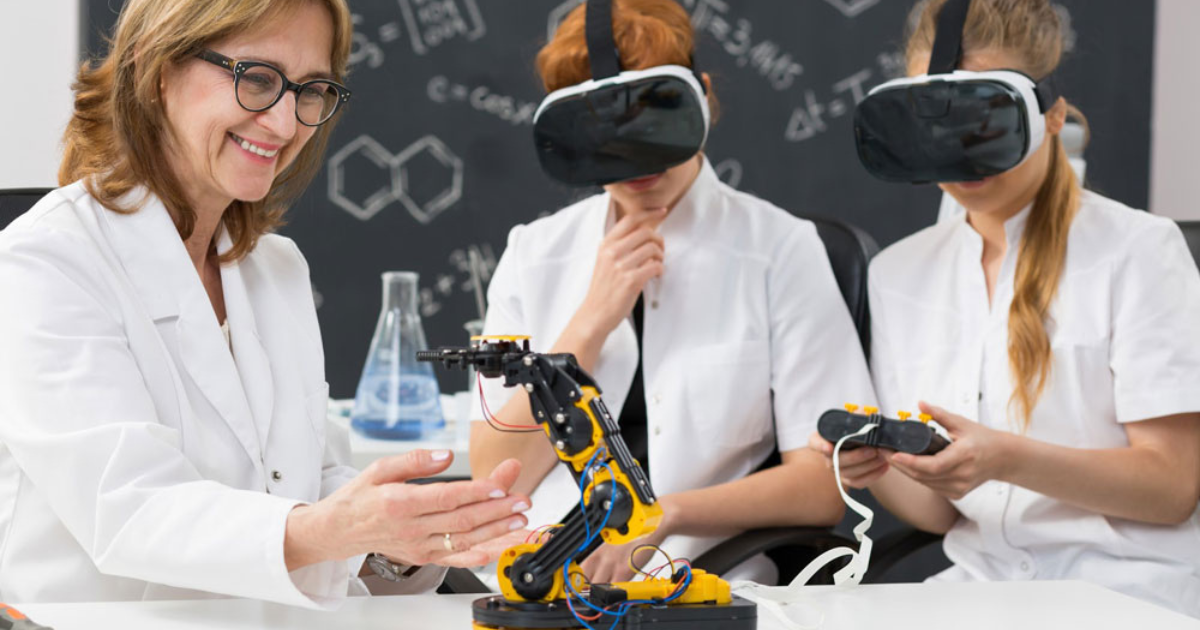
Virtual Reality in education refers to the use of VR technology to create computer-generated environments that learners can explore using VR headsets or compatible devices. These environments simulate real-world or imaginary scenarios, allowing students to interact with objects, people, and spaces in a three-dimensional setting. VR can be used through dedicated headsets such as Oculus or HTC Vive, as well as mobile-based VR systems, making it increasingly accessible for educational use.
How Virtual Reality Enhances Learning
One of the most significant benefits of VR in education is immersive learning. Instead of passively consuming information, students actively participate in lessons. This immersion helps learners stay focused and engaged, leading to better understanding and retention of information.
VR is especially effective for experiential learning. Students can visit historical locations, travel through the human body, explore outer space, or conduct science experiments in a safe virtual environment. These experiences would be impossible, dangerous, or expensive to recreate in real life.
Another advantage is improved knowledge retention. Research suggests that learners remember more when they learn through experience rather than reading or listening alone. VR stimulates multiple senses, which helps reinforce learning outcomes and improves long-term memory.
Applications of Virtual Reality in Education
Virtual Reality is being widely adopted across various educational sectors. In schools and universities, VR enhances subjects such as history, science, geography, and biology. Students can walk through ancient civilizations, explore ecosystems, or observe chemical reactions in a controlled virtual space.
In higher education and professional training, VR is used to simulate real-world scenarios. Medical students can practice surgeries, pilots can train in flight simulators, and engineers can learn complex procedures without real-world risks. This hands-on approach improves skills, confidence, and performance.
VR also plays an important role in online and distance learning. Virtual classrooms and VR-based courses provide a sense of presence and interaction, helping reduce the isolation often associated with remote education. Learners can collaborate, communicate, and learn together in shared virtual spaces.
Benefits for Teachers and Learners
For educators, VR provides innovative tools to deliver lessons more effectively. Teachers can demonstrate complex concepts visually and adapt lessons to different learning styles. VR also supports inclusive education, helping students with special needs learn through customized and controlled environments.
For students, VR encourages curiosity, creativity, and critical thinking. It allows learners to progress at their own pace and explore topics deeply. The interactive nature of VR also boosts motivation and makes learning more enjoyable.
Challenges and Future of VR in Education
Despite its many advantages, virtual reality in education faces challenges such as high costs, technical limitations, and the need for training educators. Motion sickness and device compatibility can also be concerns for some users.
However, the future of VR in education is promising. As VR technology becomes more affordable and user-friendly, its adoption will continue to grow. Integration with artificial intelligence, cloud computing, and 5G networks will further enhance VR learning experiences, making them more realistic and scalable.
Conclusion
Virtual Reality is revolutionizing education by transforming how learners experience knowledge. Through immersive and experiential learning, VR helps students understand complex concepts, retain information more effectively, and stay engaged. As educational institutions embrace digital transformation, virtual reality will play a crucial role in shaping the future of learning.